d a v e h a l v e r s o n . c o m
h o m e    :     m u s i c    :     r e c o r d i n g    n o t e s     :    e q u i p m e n t     :    o t h e r    p r o j e c t s     :    r e v i e w s     :    c o n t a c t


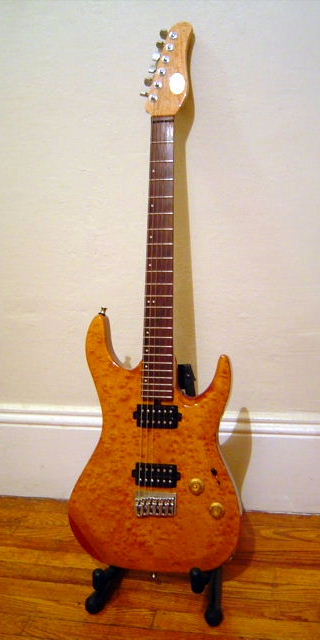
1999 U.S. Masters Vector Versatek
D’Addario XL120+
.0095 .0115 .016 .024 .034 .044

This is my main guitar, usually used in standard tuning.
It is made by U.S. Masters Guitar Works, a small manufacturer of incredibly fine instruments, located in Middleton, WI. I found this guitar (used) at Guitar Center in 2001, allegedly unloaded a few days earlier by Garry Shider (U.S. Masters endorsing artist and guitar player with George Clinton and the P-Funk All Stars). I was amazed at how everything on this guitar was exactly right when I first picked it up. All of my preferences seemed to be built-in; the neck shape, the fixed bridge, the Dunlop 6105 frets, the Sperzel locking tuners, and the tone control that actually modifies the tone in a useful way. I bought it on the spot.


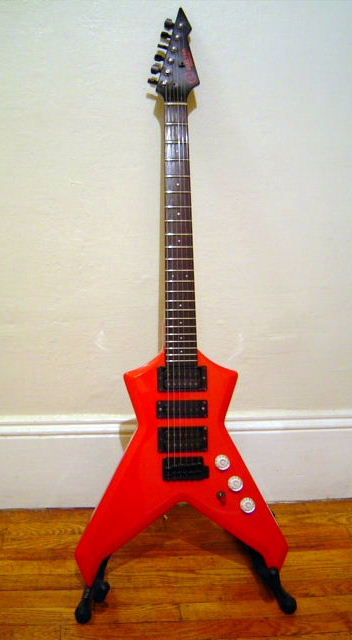
1984 Electra Westone Dynasty XV-2
D’Addario XL120
.009 .011 .016 .024 .032 .042

This was my favorite guitar for many years. I still love it. The body shape is very dated, but it looked extremely cool to me in 1984. Over the years, I have upgraded most of the parts. I attempted to upgrade the pickups in the early 1990s, but I determined that the original, inexpensive, stock pickups sounded better. This guitar has a surprisingly wide tonal range. It is often used in drop-D or other non-standard tunings.


1993 Ibanez RG-550
Ernie Ball
.022 .028 .042 .052 .064 .072

This was my main guitar for many years. It has gone through some modifications as my frustrations with the fret size and the Floyd Rose vibrato system have grown. The neck is too thin, presumably designed with speed in mind, but with little thought of stability or tuning. The Floyd Rose system sometimes makes tuning a real chore, and makes switching to alternate tunings almost impossible. However, this guitar is capable of producing some distinctive tones – worth working around some of the quirks. It is now used primarily as a detuned guitar and is usually restrung with very heavy gauge strings, allowing for notes in the bass guitar range.


1980 Kramer XKG-10
D’Addario
.009 .011 .016 .024 .032 .046

This guitar is from a strange era in the earlier days of Kramer, immediately before Kramer guitars became extremely popular. I use it primarily as the controller in my guitar synthesizer setup. It is tuned with a D-based tuning I have been using since 1991. The standard guitar output is sometimes used as well, although the tonal range is limited due to the pickup configuration (one humbucker in the bridge position). The pickup, which I believe is a DiMarzio, produces a consistent, warm tone. The aluminum neck and the Ebonol fingerboard provide unmatched neck stability. Although very heavy and strangely balanced, it is very playable in its own way.


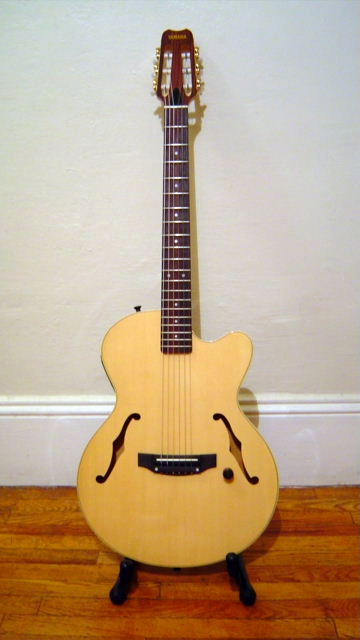
1999 Yamaha AEX-500N
Thomastik-Infeld Rope Core
.016 .024 .025 .023 .031 .039

This is a nylon string acoustic/electric guitar. I use it mostly as an electric; the body design is not optimized for acoustic tone. I use the above-mentioned strings, which are constructed of a flexible steel rope core wound with silver-plated copper (bottom 3 strings) and nylon tape (top 3 strings). These strings respond very much like nylon strings due to their lower tension, but are more playable and have a better tone. The lower tension allows extreme detuning without slacking the strings. I usually use this guitar in drop-A tuning.


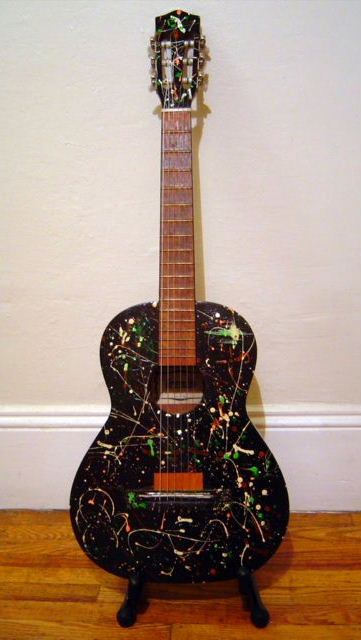
1981 Gremlin ¾ size acoustic
Thomastik-Infeld Rope Core
.016 .024 .025 .023 .031 .039

This is my very first guitar. Originally, it looked like a conventional ¾ size beginner folk guitar. I painted it in 1986 (when splatter paint seemed cool) in the first of several guitar-painting experiments. The neck is non-adjustable, and has warped slightly over the years, and I’m sure all the paint and lacquer I threw on the body didn’t improve the tone. Nonetheless, it’s still fun to play, and is occasionally useful in recording.


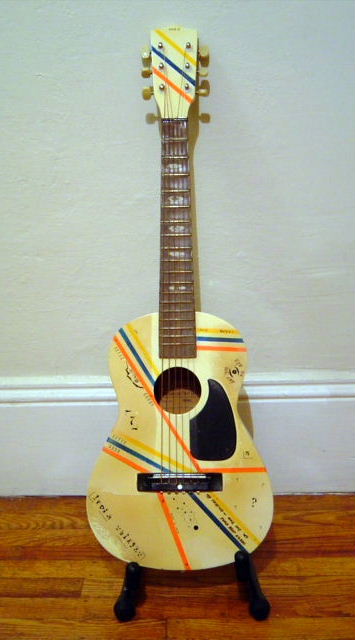
1987 Harmony ¼ size Acoustic
D’Addario Strings
gauges highly variable

This guitar was given to me years ago by a friend, and subsequently painted the next week. One of my students at the time (8 years old) had been using one of these guitars at his lessons. I was curious because it was so small and cheap, yet still had some measure of playability. This guitar has given me years of service as a travel guitar, but because of its limited usefulness, it has been subjected to many, sometimes abusive, experiments. These experiments have often yielded interesting results.


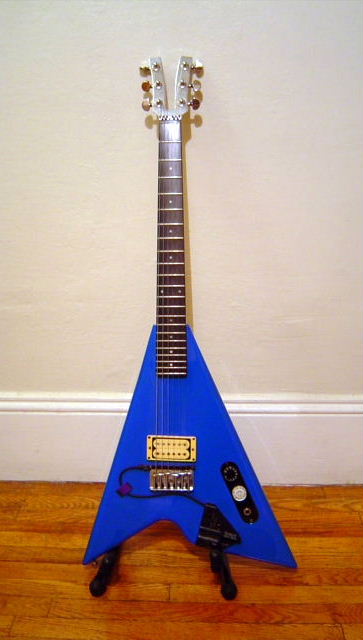
1980s NoName Stringless

This guitar was originally a rebuilding project. I painted it, installed a few parts, and stopped there. I opted to leave it stringless, reasoning that it would save me the trouble of installing electronics and tuning keys. Of course, the tonal range is greatly decreased without strings. On the upside, it’s a very quiet instrument with no tuning problems. And it looks great sitting in my living room.


Amplifiers


Tubeworks MosValve MV-962 – great for clean, focused, uncolored amplification.
Roland VGA-7 – unbelievable guitar and amplifier modeling.


Effects/Processing


Digitech GSP-2101 Studio Tube Preamp/processor – a groundbreaking unit from the mid-1990s – still an amazing tool for guitar sound design.


Antares AMM-1 Microphone Modeler – another favorite of mine – perfect for subtle or dramatic alteration of tone.


Antares ATR-1a – used for simple pitch correction or to generate very unusual sounds.


Various pedals – always good to have on hand – sometimes not appropriate for more sophisticated applications, sometimes just right.


Keyboards


Casio CA-110, Kawai D-65 – these are two very inexpensive, outdated, not-sought-after models – often the best type of keyboard from which to coax beautiful sounds.


Waldorf Micro Q (rack module) – an unbelievable module capable of creating just about anything, from scratch or randomly.


Wurlitzer Funmaker Deluxe Organ – a relic from the 1970s, with tones ranging from “incredibly bad” to “cartoonish” to “so old as to be new again” (any of which could be useful at some time).


Miscellany


Roland GR-33 guitar synthesizer – used mostly as a controller for other sound sources.

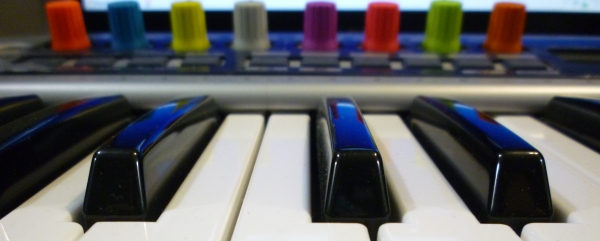
Edirol PCR-30 keyboard controller

Shure SM-57

Audio-Technica AT-822

PreSonus MP20 preamp

PreSonus Firepod

Sony PCM-R300 DAT recorder

Mackie HR824 monitors


Software


Steinberg Cubase

fxpansion BFD

Waves

BBE

Cycling '74 Pluggo

Bias SoundSoap Pro

Native Instruments